
2013 será año de cometas

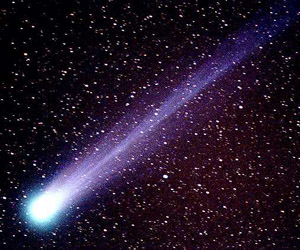 En 2012, el bielorruso Vitali Nevski y el ruso Artyom Novichonok descubrieron un cometa llamado C/2012 S1, que se dirige hacia el Sol procedente de algún lugar entre las órbitas de Júpiter y de Saturno. Según las previsiones de los astrónomos, a finales de noviembre de 2013 pasará muy cerca de nuestra estrella y alcanzará un brillo de magnitud 11,6, equivalente al de la Luna llena, lo que podría hacerlo visible durante el día a simple vista. Que un cometa sea visible en estas condiciones es poco habitual: en los últimos 332 años ha sucedido únicamente 9 veces.
Los expertos predicen que el cometa pasará a solo 1.866 millones de kilómetros del Sol cuando se encuentre en su perihelio o momento de acercamiento máximo a la Tierra. El derretimiento de enormes cantidades de hielo cometario hará que expulse grandes cantidades de polvo y gas para formar una gigantesca cola. En caso de que el cometa ISON no sea devorado ni consumido por el intenso calor del Sol, será visible hasta enero de 2014.
Curiosamente, el cometa ISON está siguiendo un camino muy similar al del famoso Gran Cometa de 1680, el primero descubierto con ayuda de un telescopio y considerado uno de los más espectaculares visto desde nuestro planeta hasta la fecha, que fue observado por el mismísimo Newton.
Los cometas como ISON son «bolas de nieve sucia» que habitan en los confines del Sistema Solar en una gigantesca envoltura compuesta por la Nube de Oort y el Cinturón de Kuiper, que probablemente se formaron, junto al resto de nuestro Sistema Solar, hace unos 4.500 millones de años. De vez en cuando choques entre ellos o el «tirón gravitatorio» de una estrella cercana son capaces de «arrancarlos» de su nube precipitándolos hacia el Sol.
Además de este cometa, la Tierra será testigo de la llegada de un cometa que no ha sido observado nunca antes, un eclipse de Luna y miles de destellos producidos por la entrada de meteoros a la atmósfera terrestre. Estas son las previsiones astronómicas para el 2013.
Nota Original: Muy Interesante
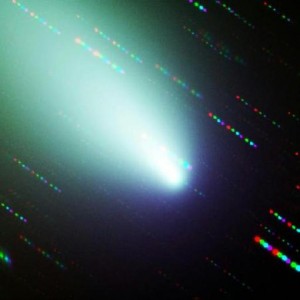 Within days after a new comet is first discovered, astronomers can tell you exactly what its path through the solar system will look like. They can calculate when it will make its closest approach to the Sun, how near it will be to Earth at any given moment and even when — or whether — it’s likely to make a return visit.
What they can’t say for sure is how brilliant a show it will put on for us. Back in the 1970’s, Comet Kohoutek was billed as the “Comet of the Century,” but it turned out to be so disappointing that it ended up as a laugh line for Johnny Carson on the Tonight Show. Even a well-known comet like Halley’s, whose 1986 appearance was ballyhooed years in advance, can turn out to be a dud.
With that caveat noted, however, there’s a reasonable chance that Earth is in for a celestial display just about a year from now. Comet ISON, discovered by two amateurs — one from Belarus, one from Russia — in September, shows early signs of being truly spectacular. At its brightest, in fact, ISON could put out as much light as the full Moon but concentrated into a smaller area — and if that turns out to be true, the term “dream comet,” now floating around the internet, would be an understatement.
There’s a legitimate possibility this might indeed be the real deal: for one thing, ISON (named for the International Scientific Optical Network, of which discoverers Artyom Novichonok and Vitali Nevski members) was first seen when it was nearly 600 million miles (965 million km) from the Sun, well beyond the orbit of Jupiter. That’s unusually distant for a comet to be spotted: these interplanetary chunks of debris usually live in the frigid realms out beyond Neptune and are more or less invisible until solar heat begins boiling ice and dust from their surfaces, forming a light-reflecting halo (known technically as its coma), that makes them seem bigger than they really are.
The fact that ISON can already be seen means it may be reasonably large — perhaps a couple of miles across — which suggests that when it dips to less than a million miles (1.6 million km) above the Sun’s fires next November 28, it may be robust enough to avoid the breakup that often happens to smaller comets. And if it does survive, ISON could go on to light up the night sky in the Northern Hemisphere for much of December, 2013 and on into January.
Comet experts are also making much of the fact that ISON’s path is very similar to that of Kirch’s Comet, a.k.a. Newton’s Comet, a.k.a. the Great Comet of 1680, which was bright enough to be seen in daylight and had a magnificently long tail (it was also the first comet ever discovered with a telescope). It’s not the same object, but it’s quite possible that both are chunks of a much larger body that broke apart long ago, maybe during its own passage through the inner solar system. The fact that such larger bodies exist isn’t in doubt: Pluto, for example, is essentially a gigantic chunk of dirty ice.
Por el respeto a esta libertad de todos, debemos informarte que Feeling.Mx y Radionautas.org se reservan el derecho a editar o publicar mensajes obscenos o bien que atenten contra la ley y la dignidad de terceros. ¡Gracias por tu aportación!
Comentarios
Entrada anterior: Germán Garmendia nos habla del amor, HolaSoyGerman (Video)
Siguiente entrada: Superpoderes antibióticos en la sangre de los pandas


