
México al Límite: Análisis Estratégico de la Crisis Económica y Política

Circula en redes sociales un extenso análisis – en inglés y «clasificado», lo que parece un documento filtrado – sobre la situación política y económica de México en vísperas de la transición presidencial, reflejando un escenario de crisis multidimensional. El informe, que abarca desde la reforma judicial hasta la relación diplomática con Estados Unidos y Canadá, pinta un panorama complejo y preocupante.

1. La situación política y judicial: El análisis señala que México enfrenta una crisis política interna, destacando la controvertida reforma judicial que ha generado protestas masivas en todo el país, con la participación de más de un millón de personas en solo 72 horas. Esta reforma, que propone la elección popular de jueces, ha sido rechazada por la mayoría de los ministros de la Suprema Corte, lo que refleja una polarización creciente.
2. Relaciones diplomáticas y amenazas externas: El posible deterioro en las relaciones con Estados Unidos y Canadá, y la amenaza de sanciones internacionales, añaden una capa de incertidumbre. Según el informe, hay un 70% de probabilidades de que Estados Unidos implemente sanciones económicas en los próximos tres meses, lo que podría incluir restricciones a las transacciones gubernamentales y un fuerte impacto en el comercio.
3. La crisis económica: El análisis proyecta una posible recesión económica para México en los próximos seis meses, con una depreciación significativa del peso. Las exportaciones mexicanas podrían caer hasta un 22%, especialmente en sectores clave como el automotriz y la agricultura, lo que agravaría la situación interna.
4. Inseguridad y crimen organizado: La evolución del crimen organizado también es un factor crítico, con un fortalecimiento de los cárteles en las zonas fronterizas y un aumento proyectado del flujo de drogas hacia Estados Unidos.
5. Proyecciones y soluciones: El análisis concluye que la administración entrante, liderada por Claudia Sheinbaum, enfrentará desafíos sin precedentes. Se recomiendan acciones inmediatas como la recalibración diplomática, un plan macroeconómico de estabilización y una estrategia de seguridad integral para frenar la violencia y el deterioro económico.
Este análisis, que se comparte ampliamente en redes, alerta sobre el punto de inflexión en el que se encuentra México, subrayando la necesidad de medidas rápidas y efectivas para evitar una crisis aún mayor que afectaría tanto la estabilidad interna como la relación con el escenario internacional.
¡AMLO NIEGA INESTABILIDAD! Desde Tulum, Quintana Roo, AMLO asegura que la reforma al Poder Judicial no provocará inestabilidad económica . El presidente afirma que la reforma es para eliminar la corrupción y desmiente los riesgos señalados por sus adversarios . ¿Se… pic.twitter.com/a6hgpu6FaU
— LuisCardenasMX (@LuisCardenasMx) September 7, 2024
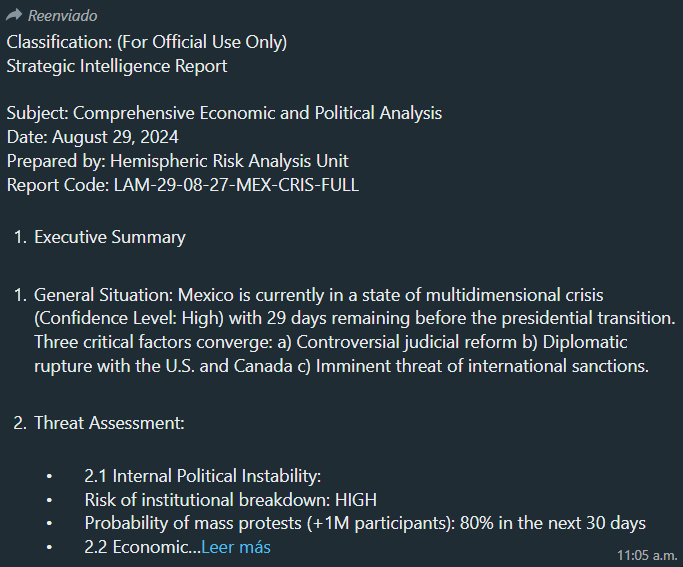
Classification: (For Official Use Only)
Strategic Intelligence Report
Subject: Comprehensive Economic and Political Analysis
Date: August 29, 2024
Prepared by: Hemispheric Risk Analysis Unit
Report Code: LAM-29-08-27-MEX-CRIS-FULL
1. Executive Summary
1. General Situation: Mexico is currently in a state of multidimensional crisis (Confidence Level: High) with 29 days remaining before the presidential transition. Three critical factors converge: a) Controversial judicial reform b) Diplomatic rupture with the U.S. and Canada c) Imminent threat of international sanctions.
2. Threat Assessment:
• 2.1 Internal Political Instability:
• Risk of institutional breakdown: HIGH
• Probability of mass protests (+1M participants): 80% in the next 30 days
• 2.2 Economic Crisis:
• Probability of recession in the next 6 months: 65%
• Projected depreciation of the peso: 15-20% in 90 days (Confidence Level: Medium-High)
• 2.3 Regional Security:
• Strengthening of cartels in border areas: CRITICAL
• Projected increase in drug flow to the U.S.: 35% in 6 months
3. Strategic Implications:
• 3.1 Short Term (0-3 months):
• Severe disruption in transborder security cooperation
• Significant increase in irregular migration to the U.S.
• 3.2 Medium Term (3-6 months):
• Reconfiguration of trade alliances in North America
• Potential destabilization of Mexican border states
4. Intelligence Evaluation: The current crisis represents the greatest threat to Mexico’s stability in the last three decades (Confidence Level: High). There is potential for rapid escalation with direct implications for U.S. national security.
5. Intelligence Gaps:
• Specific intentions of the incoming leadership regarding foreign policy
• Actual capacity of the Mexican financial system to withstand sanctions
6. Upcoming Key Indicators:
• Judicial reform voting results (expected within the next 14 days)
• Official U.S. announcement on sanctions (probability: 70% within 30 days)
• Positioning of Mexican armed forces in response to the political crisis
2. Current Political Situation
2.1 Judicial Reform
• Radical proposal to restructure the judiciary, including the popular election of judges.
• Unanimous opposition from the 8 Supreme Court justices.
• 53 mass protests in 72 hours, with an estimated 1.3 million participants.
2.2 Political Polarization
• Political Polarization Index: 9.2/10 (↑26% since July 2024)
• Presidential approval rating: 47% (↓5 percentage points in the last week)
• 32% of ruling party legislators express reservations about the judicial reform
2.3 Transition Process
• Elevated tensions between transition teams
• Delays in information handover in 45% of federal agencies
3. Economic Situation and Projections
3.1 Macroeconomic Indicators (as of September 2, 2024)
• GDP: Revised projection to 0.8% for 2024 (↓ from 1.2%)
• Inflation: 5.9% (↑0.14 percentage points in the last week)
• Exchange rate: 21.35 MXN/USD (↓4.9% since the announcement of the “diplomatic pause”)
• International reserves: $194.856 billion USD (↓$1.867 billion in the last week)
3.2 Economic Projections (next 6 months)
Month Inflation Exchange Rate Interest Rate Unemployment
Oct 2024 6.1% 21.50 MXN/USD 9.25% 3.8%
Nov 2024 6.3% 21.75 MXN/USD 9.50% 3.9%
Dec 2024 6.5% 22.00 MXN/USD 9.75% 4.1%
Jan 2025 6.7% 22.25 MXN/USD 10.00% 4.2%
Feb 2025 6.6% 22.15 MXN/USD 10.00% 4.1%
Mar 2025 6.4% 22.00 MXN/USD 9.75% 4.0%
4. International Sanctions and Impact on Mexico
4.1 Potential Sanctions Overview
• Economic Sanctions by the U.S. (70% probability within 3 months):
• Freezing of assets for 15-20 high-level officials
• Transaction restrictions with government entities (60% probability)
• Limitations on international bank transfers (40% probability)
• Trade Sanctions (55% probability within 6 months):
• Tariffs of 15-25% on key sectors (automotive, agriculture)
• 30-40% reduction in import quotas for Mexican products
• Partial suspension of USMCA benefits (35% probability)
• Diplomatic Sanctions:
• Withdrawal of the U.S. ambassador (30% probability within 2 months)
• Visa restrictions for officials and their families (65% probability)
4.2 Projected Economic Impact
• External Sector:
• Exports: ↓18-22% in 6 months
• Automotive: ↓25-30%
• Agriculture: ↓20-25%
• Manufacturing: ↓15-18%
• Foreign Direct Investment: ↓40-50% in the next year
• $15-18 billion USD in cancelled or postponed projects
• Financial Sector:
• Exchange Rate:
• Base scenario: 23.50-24.50 MXN/USD in 3 months
• Severe scenario: 26-28 MXN/USD
• Stock Market: ↓25-30% in the IPC
• Interest Rates: ↑150-200 basis points
• Public Finances:
• Fiscal deficit: ↑5.5-6% of GDP (from 3.8%)
• Public debt: ↑58-60% of GDP
• Sovereign bond yields: ↑300-350 basis points
3.3 Fiscal Implications:
• Severe reduction in public spending capacity in the next 6-12 months
• High probability (75%) of significant cuts in key social programs
• Elevated risk of sovereign credit rating downgrade in the next 3-4 months
5. Security and Organized Crime
5.1 Crime Statistics (projections for the next 6 months)
• Homicides: ↑8% (19,500 estimated cases)
• Kidnappings: ↑15% (650 projected cases)
• Drug trafficking: ↑35% in flow to the U.S.
5.2 Evolution of Cartels
• Strengthening of CJNG in border states
• Fragmentation of the Sinaloa Cartel into 4 main factions
• Emergence of 9 new regional criminal groups
5.3 Security Forces Operational Capacity
• ↓25% in joint operations with U.S. agencies
• ↓40% in intelligence sharing with the U.S. and Canada
6. Social and Political Impact
6.1 Employment and Poverty
• Unemployment rate: ↑6.5-7% (from 3.8%)
• Population in poverty: ↑5-7 percentage points (6-8 million additional people)
• Informal economy: ↑65-70% of the workforce
6.2 Social Stability
• 80% probability of protests with +1 million participants in 3 months
• ↑150% in strikes and work stoppages
• ↑70-100% in attempts at irregular migration to the U.S.
6.3 Governance
• Presidential approval: ↓30-35% in 6 months
• 60% probability of severe governmental crisis
7. Critical Sectors at Risk
7.1 Critical Infrastructure
• Energy: Risk of electricity shortages in 5-7 states
• Telecommunications: 70% of infrastructure vulnerable to cyberattacks
7.2 Public Health
• Partial collapse in 30-40% of public hospitals
• Critical shortages in 50-60% of essential medications
7.3 Education
• ↑25-30% in school dropout rates (middle and upper levels)
• ↓60-70% in funding for scientific research
8. Risk Analysis and Scenarios
8.1 Critical Risks
• Constitutional crisis due to judicial reform (65% probability)
• Severe economic recession (55% probability)
• Escalation of organized crime violence (70% probability)
• Total diplomatic breakdown with the U.S. (25% probability)
8.2 Most Probable Scenario (60% probability)
• Partial implementation of judicial reform
• Economic contraction of 1.5% in the first two quarters of 2025
• Tense renegotiation of relations with the U.S. and Canada
• Significant increase in violence in 5-7 key states
9. CONCLUSIONS
The multidimensional crisis facing Mexico represents a critical turning point not only for the country’s internal stability but also for the geopolitical balance of North America as a whole. The unprecedented convergence of internal institutional fractures, regional diplomatic breakdowns, and external economic pressures has created a scenario of extreme volatility, with the potential to fundamentally reshape the hemispheric strategic landscape.
The impending presidential transition to Claudia Sheinbaum’s administration is occurring in an unprecedented context of volatility, necessitating a series of immediate and decisive actions to stabilize the country’s situation and reposition Mexico on the international stage. The following measures are identified as critical for the first 100 days of government:
1. Urgent Diplomatic Recalibration:
• Immediate establishment of a high-level trilateral working group with the U.S. and Canada to renegotiate terms of cooperation in security and trade.
• Implementation of a “diplomatic reset” strategy, including priority state visits and the appointment of special envoys with broad international credibility.
2. Macroeconomic Stabilization:
• Presentation of a credible austerity and fiscal efficiency plan, with quantifiable medium-term deficit reduction targets.
• Negotiation of an expanded flexible credit line with the IMF as a stabilization mechanism and a sign of confidence to international markets.
3. Consensus-Based Judicial Reform:
• Call for a national justice pact that includes all political forces, the judiciary, and civil society to redesign the judicial reform on a consensual basis.
• Implementation of an accelerated program for the professionalization and cleansing of the judicial system, with international oversight.
4. Comprehensive Security Strategy:
• Deep restructuring of strategies to combat organized crime, prioritizing the dismantling of financial and logistical structures.
• Creation of an inter-agency task force with international participation to address the security crisis in critical states.
5. Targeted Economic Revitalization:
• Launch of a fiscal and regulatory incentive program to attract investments in strategic sectors, with an emphasis on nearshoring and renewable energy.
• Implementation of a critical infrastructure plan with public-private participation, focused on regions with high economic potential and social vulnerability.
6. Institutional Strengthening:
• Proposal of a constitutional reform to strengthen the autonomy and capacities of regulatory and anti-corruption bodies.
• Implementation of an open government system and real-time accountability for all federal agencies.
The effectiveness of these measures will depend crucially on the Sheinbaum administration’s ability to build broad consensus, both nationally and internationally. The successful implementation of this agenda is not only vital for Mexico’s immediate stabilization but will also lay the foundation for the country’s reconfiguration as a stable and reliable actor on the global stage.
Temas: Análisis Estratégico, Canadá, Crisis Económica y Política, Estados Unidos, México, México al Límite, Strategic Intelligence Report
Por el respeto a esta libertad de todos, debemos informarte que Feeling.Mx y Radionautas.org se reservan el derecho a editar o publicar mensajes obscenos o bien que atenten contra la ley y la dignidad de terceros. ¡Gracias por tu aportación!


