
Las caras de la Luna que se verán en 2012

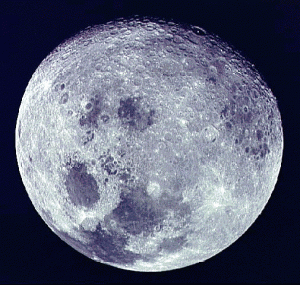 La NASA dio a conocer una recreación de cómo se verá al satélite natural durante todo el año desde la Tierra. La animación, con datos de la sonda LRO, fue dada a conocer por el centro espacial Goddard.
El astro no siempre se muestra de la misma manera. En su rotación axial, y a lo largo de un mes, modifica su orientación. A ese fenómeno se lo conoce como libración (que significa ‘balanza’ en latín) y es lo que genera que la visión desde el planeta Tierra sea desde distintos ángulos, según el momento.
Este video de la NASA permite observar as irregularidades de la Luna. El 10% de los extremos es distinto uno de otro. En la animación, que dura menos de tres minutos, se hace más sencillo identificar el fenómeno. El material fue realizado por el centro espacial Goddard, sobre la base de los datos provistos por la sonda Lunar Reconnaissance Orbiter (LRO).
Aquí el video:
http://www.youtube.com/watch?v=_j_W9MUOGKI
*Nota de universetoday.com
Look, It’s a Moon Buggy! LRO’s Best Look Ever at the Apollo 15 Landing Site
A new image from the Lunar Reconnaissance Orbiter’s Narrow Angle Camera provides the most detailed orbital look ever at the Apollo 15 landing site on the Moon. The image of the Hadley plains shows the hardware left behind by astronauts Dave Scott and Jim Irwin and the tracks from the lunar rover.
“We like to look at the Apollo landing site images because it’s fun,” said LRO principal investigator Mark Robinson said at a briefing last year on LRO images. And these latest images are really fun, as look how clearly the lunar lander and the ‘Moon buggy’ show up! (Click images for larger views.) Additionally, we can basically follow all the movements of the rover and the astronauts during their 67-hour stay on the Moon’s surface in August of 1971.
Apollo 15 was the first mission to have the Lunar Rover, which allowed the astronauts to traverse far from the Lunar Module and explore much more local geology than the astronauts on the previous missions (Apollo 11, 12, 14).
“Not only did the LRV allow the astronauts to move from place-to-place at a lively rate of eight to sixteen kilometers per hour (five to ten miles per hour), but the LRV also allowed brief periods of rest that in turn helped to conserve oxygen,” said Robinson on the LROC website.
Temas: Centro Espacial Goddard, Ciencia, Luna, NASA
Por el respeto a esta libertad de todos, debemos informarte que Feeling.Mx y Radionautas.org se reservan el derecho a editar o publicar mensajes obscenos o bien que atenten contra la ley y la dignidad de terceros. ¡Gracias por tu aportación!
Comentarios
Entrada anterior: También los arbitros son rompecorazones
Siguiente entrada: Smartphones que dan terapia


